Tuesday, 29 July 2025

R&J First questions!

 Click on the link for questions below, and do the following:

I.i: 1, 5, 6, 7, 11, 12, 13

I.ii: 2, 4, 5

I.v: 1, 2, 3, 4, 5

II.ii: 1, 2, 4, 6, 7, 8

Monday, 28 July 2025

Romeo and Juliet

 In addition to a final Double Entry Journal, we'll be doing a few questions for Romeo and Juliet. Please check in to see which questions we'll be doing - we do not have time to do them all.

CLICK HERE FOR THE COMPLETE QUESTIONS PACKAGE.

Reminder: Please wait to see which questions we'll be doing in class.

Friday, 25 July 2025

Essay Topics!

 Greetings all, here are our essay topics!

  1. How does Squealer manipulate language to deceive the other animals and maintain the pigs’ dominance? Analyze Orwell’s use of propaganda and euphemism using direct citations for support.
  2. How does Boxer’s blind loyalty, work ethic, and tragic fate reflect the exploitation of the working class under oppressive governments? Use specific quotations and citations from Animal Farm to support your answer.
Some tips based on our last essay:
  • Make sure that you explain how your quote/citation supports your thesis directly.
  • Please use integrated quotes.
  • Follow the essay guide - 5 paragraphs (1 intro, 3 body, 1 conclusion)

Wednesday, 16 July 2025

Cask of Amontillado

Today we're doing quotes! Use these questions for Amontillado to guide you.

  1. Find two examples of irony in "The Cask of Amontillado"? (Any kind of citation)
  2. Why did Montresor seek revenge of Fortunato? (Integration)
  3. What weakness does Fortunato possess that Montresor plans to take advantage of? (Integration)
  4. What is Fortunato's state when Montresor meets him? What is he wearing? How does he act? (Integration)
  5. Where does Montresor lure Fortunato? (Integration)


Tuesday, 15 July 2025

Harrison Bergeron: Response

 Today we've done a little comparison between the film and the short story, and wrote about the similarities and differences between the two. Now that it's done - it's time for a quote and response:

"The road to hell is paved with good intentions." - English proverb

Read the above sentence and think about how it applies to Harrison Bergeron, and maybe - some real life examples, too!

After this big response, do #2 and #4 in the book! :)

Wednesday, 9 July 2025

The Scarlet Ibis: Composition

 Pick one topic. First - make a plan on the criteria sheet; find evidence and write ONE SENTENCE for your claim. 
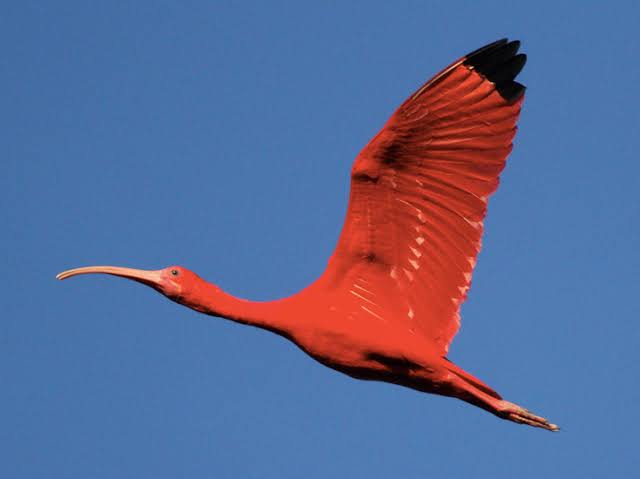
  1. What does James Hurst teach about Pride in "The Scarlet Ibis"?
  2. What does James Hurst suggest about our nature as children in "The Scarlet Ibis"? (think about if he's saying they're selfish/selfless or that they may not understand complicated adult emotions)

Tuesday, 8 July 2025

The Scarlet Ibis: English 10 Adapted


THE SCARLET IBIS

  1. Give two examples of pride in "The Scarlet Ibis"
  2. How do the narrator's feelings towards Doodle change over time?
  3. What is one important message that "The Scarlet Ibis" relays to present-day children with siblings?
  4. Where do we see foreshadowing in "The Scarlet Ibis"? Find two examples.
  5. Is the narrator to blame for Doodle's death? Why or why not?

Monday, 7 July 2025

Just Lather, Nothing Else

 Here's our work for Just Lather!

For the first part of the morning:

  1. What kind of person is Torres? Use quotations as evidence with citations!
  2. Why didn't the barber kill Torres?
  3. Did the barber make the right decision? Why or why not?

Friday, 4 July 2025

In-Class Writing for : THE SNIPER

The Sniper is descriped as a "fanatic". How does being a fanatic affect their ability to reflect on their own actions?

  • Use some examples from the story.
  • Add your own ideas an opinions!
  • 2+ paragraphs
  • Pen/Pencil
  • NO PHONES

Thursday, 3 July 2025

English 10 Adapted: The Sniper

 Today we'll read "The Sniper" and learn how to do an "Elements of Fiction" handout and a Double Entry Journal!

Monday, 30 June 2025

Welcome to English 10 Adapted

 Greetings and welcome!

If you see this post, that means you can access my blog where many of our materials will be available for digital access. Check the links at the top: Resources and Texts are where we'll be finding some of our short stories.

For today, we'll be getting our course outline and checking report cards to make sure you're a-okay to be in this course. REMEMBER: English 10 Adapted is designed for ELL learners who have FINISHED ELL3. If you are not an ELL student, you must take a different course.

Attendance is very important during summer school; teachers and administrators are obliged to take attendance very carefully. Missing classes can set you profoundly behind - do you all you can to attend every class.

  • After our little intro, we will make name tags. Yes! I need to know your names and it is a learning process for me as well!
  • I will collect a writing sample from students on the first day. You'll get a topic that should be easy to understand. This will serve as a baseline/starting point.
  • Depending on timing, we will have our break, and move on to the big notes that we need to take to get us started on our first unit: Short Stories!
Writing Rules:
  • No phones/translators/digital devices
  • No outside notes
  • No use of AI of any kind
  • Pen/Pencil is okay
  • Double space
I realize that some of you may have depended on technology to help you understand and expand your writing, but you must ultimately be able to do these things by yourself. That means hard work and struggle - but this is how we grow and become stronger students.

Wednesday, 18 June 2025

Ratatouille Stuff!

We've just finished the film and it's time to write! 

In Ratatouille, Remy is a rat who dreams of becoming a great chef. Although the world tells him he doesn't belong in the kitchen, his passion and talent help him succeed in surprising ways.

"Can greatness come from unexpected places?"

"How can teamwork help you to accomplish more than you could have alone?" 

Use examples from the film and your own ideas to support your answer.

Tuesday, 10 June 2025

English 12: Final Essay

Topic time. Though this technically falls into the synthesis essay and literary essay, how we cite and work with film in this kind of essay is quite different than how we work with text. Check the criteria handout. Today, start your research and find sources to support your position.

Read the topic carefully. It's one thing to just write freely about existentialism, but each topic has a specific framework you must follow to be on topic. 

1. Sartre’s Hell is Other People: Isolation and the Self

Consider Sartre’s notion that “hell is other people.” How do the interactions among the crew (or between Willard and Kurtz) illustrate existential isolation, bad faith, or authenticity? Analyze how characters struggle with self-definition in the face of others’ expectations and judgment.

2. “I Love the Smell of Napalm”: Kilgore and the Absurd Hero?

Analyze the character of Lieutenant Colonel Kilgore through the lens of Camus’ concept of the absurd. Does Kilgore embody the absurd hero, confronting the meaningless violence of war with passionate intensity and personal code, or is he a figure of existential denial? Consider how his flamboyant behavior, love of surfing, and surreal detachment from the war reflect or contradict Camus’ ideas in The Myth of Sisyphus.

3. Kurtz and the Collapse of Essentialism

Colonel Kurtz appears to have abandoned traditional moral frameworks and embraced a new identity. Does Kurtz’ transformation reflect the existential rejection of essentialism? Discuss how his philosophical evolution compares with existentialist ideas found in the writings of Camus, Kierkegaard, or Sartre.

Breadwinner

Respond to both of these in an extended response. Your response should be at least one paragraph for the first question, and 2 paragraphs for the 2nd. 

  • How did The Breadwinner help you understand life in Afghanistan under Taliban rule?

  • Parvana often breaks rules to help her family. How do we know when the rules should be broken to do the right thing?

Monday, 9 June 2025

The Breadwinner

Choose 5 central themes from a list and:

  • Explain how each one appears in the film.

  • Provide a key scene or moment that represents it.

Theme options:

  • Courage

  • Freedom

  • Family

  • Storytelling

  • Injustice

  • Identity

  • Hope

  • Survival

  • Gender roles

More Existentialism!

 We're going to zoom in on Camus, Sartre, and Kierkegaard. For this activity, we break into three groups and create a poster that gives us some information on each of these renowned philosophers and their contributions to existentialism.

For whichever philosopher your group gets, organize the following information:

  1. What is their contribution to Existentialism?
  2. Where are they from?
  3. What are their unique beliefs?
  4. How do they differ from the other two philosophers?

Kierkegaard

https://www.youtube.com/watch?v=D9JCwkx558o

Sartre

https://www.youtube.com/watch?v=3bQsZxDQgzU

Camus

https://www.youtube.com/watch?v=jQOfbObFOCw

The Search for Yourself

Existentialism makes reflection meaningful. Without this background, reflections can seem meaningless or like grunt work (in fact, a nihilist would say that all reflection is meaningless). Existentialism requires us to take responsibility for our lives, our values, and our direction. It refutes essentialism, which argues that there is an essence that makes you, you (as defined by someone, or something else). Some terms to inform our discussion:

Determinism: The idea that our lives are pre-determined. There are several angles to this school of thought. Some believe that God has determined every aspect of our lives, others feel that every aspect of our personality is the product of chemical reactions and electrons moving through our brain; that there are essentially aspects to our existence that we will likely never fully understand that influence us in subtle ways that ultimately determine how we live.

Free Will: Refutes determinism. Our actions are entirely of our own making. We have control over our future and how our lives turn out. We must be responsible and accountable for every aspect of our lives. Free will is a battle over the hardship of reality, 


For the following scenarios, describe how free will and determinism will explain their thinking differently:
  1. A boy steals bread to feed his family.
  2. A man hijacks a plane, and crashes it into one of the twin towers.
  3. A young lady on the verge of bankruptcy wins the lottery.
  4. A young lady loses her house due to her gambling addiction.
  5. A student hasn't handed in any assignments because they have been staying up late playing video games.
  6. A student has fumbled during their soliloquy presentation.
  7. Another student in your class seems to have everything going for them. Good marks, good relationships, good money.

Monday, 2 June 2025

Some more writing

Imagine that your school is going to add a new class or club, and you get to decide what it will be. What kind of class or club would you create? Who would join it, what would you do there, and why would it be helpful or fun for students?

Tips to help you:

  • Describe the purpose of your class or club.

  • Explain who it’s for and what kinds of activities it would include.

  • Be creative, but stay clear and organized.

  • Use sentence connectors to show cause, contrast, and addition.

English 12

Write a singular response that covers the following questions:

  • Do you believe people are born with a purpose?
  • Have you ever questioned the meaning of something you were expected to do?

Friday, 30 May 2025

Prompt:
Imagine you are planning a school event, like a cultural fair, talent show, or sports day. Describe what kind of event you would plan, who would participate, and how you would organize it. Explain why you think this event would be fun and meaningful for your classmates.

Requirements:
In your response, use at least two complex sentences and two compound sentences (sentences joined by conjunctions like and, but, or, so, yet). Try to write one or two full paragraphs.

Tips to help you:
  • Start by describing your event idea.
  • Use transition words like because, although, since, if, when for complex sentences.
  • Use conjunctions like and, but, or, so to connect ideas in compound sentences.
  • Think about who would help you and what you would need to prepare.
Example sentence starters:
“If I could plan a school event, I would choose...”
“My classmates would enjoy it because…”
“We would invite students and teachers, and...”
“Although it takes a lot of work, I believe it would be worth it.”

REMEMBER TO PROOF READ!

The Examined Life

 English 12

In our final unit, you will be challenged with some high-level thinking through existentialism. We'll figure out some new terms, learn about Joseph Campbell and watch a film, Apocalypse Now - based on his novel The Heart of Darkness. 

Beware, this is a rabbit hole that will have you ask questions about yourself. The ideas in this unit will challenge your thinking about identity, faith, and the meaning of life. This knowledge can be used to begin understanding how you can accomplish self-actualization. Sound familiar?

Maslow's Hierarchy of Needs


ESSENTIALISM vs EXISTENTIALISM (this idea rejects essentialism):

https://www.youtube.com/watch?v=YaDvRdLMkHs

Video on Existentialism, Absurdism, and Nihilism:

https://www.youtube.com/watch?v=qaIbUAkSYEU

*Note - the sponsor for the above video is in hot water. Please skip over the sponsored segment from  1:17 - 2:17.

First, answer these questions. This will show you how existentialism affects you.

  1. Do you have particular worries about the future?
  2. Have you been through a major event that had you rethink your values, beliefs, and goals?
  3. Consider your educational goals for next year. Have they been defined by someone else, or yourself?
Now, after watching the videos, answer these.
  1. What is 'the absurd'?
  2. What is nihilism?
  3. How does an existentialist find meaning?
  4. How does existentialism differ from essentialism?

Tuesday, 13 May 2025

Brian's Struggle

 In Chapter 15, things go fairly well for Brian, for chapter 16 - well it's not so great. With the crisis that takes place...

Write a journal entry as Brian after the events of Chapter 16. Think about how he might be feeling? What will he do next? Is there really anything he could have done differently?

Friday, 25 April 2025

ELL3

To help with today's work, we'll use the blog to guide our steps. First we'll break into groups, then assign roles:
  • Mental Resilience Coaches (Ch. 5–8): How does Brian’s mindset change? Create a "survival pep talk." (A pep talk is supposed to be encouraging and supportive. It's meant to put people in tough times into a better mood about themselves).
    • Think about the encouragement his teacher had given him.
    • Think about Brian's realizations after facing a difficult problem (Porcupine)
After, find 3 key quotes/passages related to the topic. Once you have this, it's time to evaluate Brian's approach to his mental resilience. How does Brian's ability to reflect on his challenges helping him to survive?

Tuesday, 15 April 2025

English 12: Synthesis

 Greetings grads! 

First of all, thank you for your wonderful topic ideas and research. I have reviewed these items and determined some topics for our selection, including the supplementary text to support your preparation. This will be a lengthy post including abstracts and context. Here we go.

Friday, 11 April 2025

Synthesis Prep

Today we're going to do a practice run in synthesis writing. To do this, we will use 1984 as our primary text and Zimbardo's The Lucifer Effect as our supporting synthesis text. Feel free to collaborate as we brainstorm a claim and argument.

The Lucifer Effect is where Philip Zimbardo wrote on the Stanford Prison Experiment. In this experiment, subjects were assigned roles as prisoners and prison guards. It had horrific outcomes; in short, it revealed that people will easily conform against their own morals in the presence of an authority figure. First, a practice topic:

How do both Orwell and Zimbardo demonstrate that oppressive systems rely on institutionalized roles and controlled contexts to enforce conformity?

For each of the following quotes from The Lucifer Effect, find specific examples in 1984 that may be explained by this new evidence.

Systemic Power and Dehumanization

"The System’s power comes from its ability to control the social context... Once you institutionalize roles and rules, you create a situation where people mindlessly follow scripts handed to them by authorities." (Chapter 12, p. 210)

Connection to 1984:
The Party’s control over language (Newspeak), surveillance (telescreens), and rituals (Two Minutes Hate) mirrors Zimbardo’s "scripts."

Winston’s job at the Ministry of Truth is a "role" that forces him to conform, even when he resists.

Conformity and Peer Pressure
"The normative influence of groups leads individuals to conform, not out of fear of punishment, but because they want to belong. This is how ordinary people can endorse atrocities—not because they are evil, but because the system rewards compliance." (Chapter 5, p. 89)

Connection to 1984:
The Spies and Junior Anti-Sex League indoctrinate children to report "thoughtcrimes," showing how peer pressure sustains the Party’s power.

Winston’s coworker Parsons is proud when his daughter denounces him—a chilling example of conformity overriding familial bonds.

Obedience to Authority
"The Stanford Prison Experiment revealed that when people are given unchecked power, even for a short time, they readily adopt abusive roles... The situation, not individual pathology, drives cruelty." (Chapter 11, p. 193)

Connection to 1984:

O’Brien tortures Winston not out of personal hatred but because the Party demands it.

The Thought Police act as enforcers of the system, much like Zimbardo’s "guards."

Cognitive Dissonance and Doublethink
"When people are forced to act against their beliefs, they often rationalize their actions to reduce mental discomfort. This is how oppressive systems sustain themselves—not just through force, but through the victims’ own psychological adjustments." (Chapter 14, p. 255)

Connection to 1984:

Winston’s eventual acceptance of "2 + 2 = 5" mirrors this idea.

The concept of doublethink (holding two contradictory beliefs) is a direct parallel.


Hatchet Chapter 1 - 4 writing!

Here's our writing prompt for the first part of the book! (Chapter 1 - 4)
  1. Internal Monologue: Imagine you are Brian right after the crash. Write a journal entry from his perspective, describing his immediate emotions, fears, and first thoughts about survival. Think about how you might process what has happened.

Monday, 7 April 2025

1984: Chapter 3 & 4 Part 3


  1. How does O’Brien’s explanation of power and control in Chapter 3 reflect the Party’s ultimate goals?

Consider O’Brien’s statement: “Power is not a means; it is an end.” How does this philosophy justify the Party’s use of torture, manipulation, and the destruction of objective truth? Does this view of power make the Party’s rule sustainable, or does it contain inherent flaws?
  1. In Chapter 4, Winston is forced to confront the idea that reality exists only in the mind of the Party. How does his resistance (or eventual acceptance) of this idea demonstrate the effectiveness of the Party’s psychological control?

Winston initially clings to the belief in objective truth (e.g., “2 + 2 = 4”), but O’Brien insists that the Party controls reality. Does Winston’s struggle suggest that total mental domination is possible, or does his internal conflict reveal a limit to the Party’s power?

Thursday, 3 April 2025

1984: Part 3 chapter 1-2

In Part 3, Chapter 1 of "1984," Winston is taken to the Ministry of Love. How does Orwell use the setting to reflect the themes of control and oppression? Provide specific examples from the text to support your analysis.

How does Orwell use the character of Parsons in Chapter 1 to illustrate the effects of Party indoctrination? Analyze how Parsons' behaviour and beliefs reflect the Party's influence on individuals.

In Chapter 2, how does the Party's manipulation of truth and reality affect Winston's perception of himself and the world around him? Explore how this manipulation challenges Winston's sense of identity and reality.

Discuss the significance of the phrase "2 + 2 = 5" in Chapter 2. How does it relate to the theme of control over thought? Analyze how this phrase encapsulates the Party's power to dictate reality.

Wednesday, 12 March 2025

To Build a Fire: ELL3

This story was so tragic!
  1. What are the big mistakes that the main character makes on his journey?
  2. Why did the man need to build a fire? (each time)
  3. Why did the last fire go out?
  4. How do we know that the man is too confident? Find examples in the story.
  5. What emergency happens that causes the man to build a fire? Why is this event an emergency?
  6. Why did the main character ignore the old man? (Use your own thinking!)
  7. Where does this story take place and why is the man here?
  8. Why does the man try to kill the dog, and why is he unable to do it?
  9. In this desperate situation, how do the dog and the man differ in their ability to survive the cold?
Longer answer:
Can overconfidence ever be good or helpful?

Could this story have ended with the man's survival? What could he have done differently in order to survive?

Tuesday, 4 March 2025

PARAGRAPH(s)

PARAGRAPH(s)

Describe an ideal vacation. Think about these questions in your answer - why would you travel there? What activities would you plan? Who would you bring? 

Monday, 3 March 2025

Freud and Owell

Sigmund Freud, founder of psychoanalysis had much to say on the operation of our psychology. With a close look at Winston Smith in 1984, we see many opportunities for parallels. Check out the diagram in class for a little overview of his ideas.

All of the following quotes belong to Sigmund Freud:
  • "Repression is the foundation on which the whole structure of psychoanalysis rests."
  • "Dreams are the royal road to the unconscious."
  • "Unexpressed emotions will never die. They are buried alive and will come forth later in uglier ways."
Find a parallel in part 1 for each quote. No need for citations from 1984 for this one. Simply identify a chapter and explain in a few sentences and elaborate on similarities.

And a tough one:
  • "Most people do not really want freedom, because freedom involves responsibility, and most people are frightened of responsibility."
You may have to interpret a little :)

ELL3: Choose 1!

PICK ONE!
  1. In A Knight’s Tale, William pretends to be a nobleman to compete in jousting tournaments. How does the film show the idea of changing who you are? Do you think William’s actions are right or wrong? Use examples from the film to explain your answer.
  2. William works very hard to go from being a peasant to a knight. How does the film show the challenges and rewards of following your dreams? Do you think hard work is enough to succeed, or do you also need luck? Explain your answer.


Friday, 28 February 2025

Part 1 chapter 4

  1. How does the Party use language and memory to maintain power? Find at least two examples (with quotations) from Chapter 4 that demonstrate how the Party manipulates language and memory to control the population.
  2. How does Chapter 4 develop the theme of truth and reality in 1984? Find at least three quotations that show how the Party distorts truth and creates its own version of reality. What is Orwell suggesting about the nature of truth in a totalitarian society?

Thursday, 27 February 2025

English 12


We'll be writing a synthesis essay in the later stages of 1984. Going forward we'll be reading quite quickly. Complete the comprehension handouts and we'll look over these items in class to begin our overview.
  1. Essay arguing the current validity of 1984 (Kakutani)
  2. Why Nobody Cares The President is Lying (Sykes)
  3. All of the Passages in 1984 that relate to you right now (Temple)
  4. Letter that explains why Orwell wrote 1984 (Orwell)

Also, here is Orwell's Essay: Politics and the English Language cited from the video.

Monday, 24 February 2025

A Sound of Thunder

ELL3: Here we go!

  1. How does the story show that people want to control nature? What are some good ways and bad ways that it shows this?
  2. The "path" in the story is an important symbol. Think about why Eckels steps off the path and why Travis says we must not step off the path. Eckels thinks he is brave and courageous, but when he sees the dinosaur, he loses his courage. Of course, we don't want to change the past, but Eckels does it anyway. What does the path represent in the story?
  3. In what ways does the story warn against using technology in bad ways?
  4. Look at the part of the story that describes the tyrannosaurus rex. Find 3 examples that describe it in a scary way. Use quotation marks! After you find 3 quotes, explain how each one creates a scary effect.
    1. Example: "Eckels swayed on the padded seat," (p. 363)

Tuesday, 18 February 2025

Post-Presentation: TYFUB Reflection

 Greetings Grade 12s! After your presentation, please submit a brief reflection on the process and production of your presentation. Answer the questions and put your name at the top:

  1. What was your role in the development of the project? What did you contribute?
  2. During the presentation, what portion did you present? 
  3. Did you feel the work was fairly distributed and balanced within your group?

Tuesday, 11 February 2025

All Summer in a Day


Here's our short story, ELL3!

All Summer in a Day

Once we read we'll do some questions! Please use several sentences for each one. Explain your answer with evidence from the story.

  1. Why do the other children resent Margot? How do they express their jealousy?
  2. How does the story explore the theme of jealousy? How does jealousy influence the children’s actions?
  3. What does this story teach about jealousy? Explain.
  4. The sun is an important symbol in the story. What does it represent? How does it affect those who have never seen it before, how has it made Margot different than the others?
  5. What might this story suggest about how society treats people who are different.

Thursday, 6 February 2025

Omelas Topics

  1. By imagining and co-creating this city of Omelas with Le Guin, do we share a responsibility for the suffering of the child in the basement? (this is an allegorical question; obviously we don't lock a child away in a basement somewhere in Richmond)
  2. How might the contrast of childhood and adulthood (or at least puberty), be represented through the coming of age in Omelas? Why are youth the first ones to consider walking away?
  3. Is the sacrifice of something precious a worthy trade-off for the pleasure and comfort of thousands?
  4. Why does Le Guin use such thoroughly exaggerated pleasures to allegorize our own? How do these pleasures echo the kinds of pleasures we pursue?

Tuesday, 4 February 2025

ELL3

 Raymond's Run.

  1. How does Squeaky’s personality change throughout the story? What events contribute to this change?
  2. What does Raymond’s Run suggest about competition and personal growth?
  3. What message does the story convey about disability and inclusion?

Omelas Prep

 Here you go grade 12s! Find quotes to support these topic areas. These are not the essay topics but your essay topics will be connected to them.

The Ones Who Walk Away From Omelas.

  • Our Imagination as a vehicle for Complicity: As the narrator invites the audience to create an image of Omelas, we become complicit in the moral consequences of its greatest crime: the agreement to allow a child to continue suffering in order for everyone else to be happy. By reading this story, Le Guin pulls us in to its creation, generating consensus and understanding of our circumstances.
  • Coming of Age and the Loss of Innocence: All children between 8 and 12 learn about the child in the basement. At this discovery, the narrator states that everyone is disgusted and horrified at first. 
  • The utilitarian scapegoat. A child suffers in a basement somewhere in Omelas so that thousands of citizens can live in bliss and comfort. Evaluate the pleasures of Omelas' citizens in light of the suffering that this child must endure. 
  • The absurd pleasures we desire. Many pleasurable behaviors described in Omelas come across as bizarre. Motifs such as nudity, music, drugs, and plenty of contradictions populate Le Guin's narrative. 

Monday, 20 January 2025

Apocalypse Now: Part 3

 Reminder: I'll collect all three parts of our responses!

Here's part 3.

Context: Willard and his team finally arrive at Kurtz' camp. There are bodies and indigenous people everywhere who follow Kurtz like a god.

1. In his pre-death line Kurtz says, "We train young men to drop fire on people but their commanders won't allow them to write F___ on their airplanes because it's obscene!" What does Apocalypse show about the duality of absurdity? 

(There's the absurdity of war - which is that war is pointless - a nihilistic view, and there's Camus' "The Absurd" where we must find meaning for ourselves (Existentialism)

2. Did Willard adopt Kurtz' existentialist/nihilistic view of the world before he killed him? Or did Willard confront Kurtz because his essentialist perspective was incompatible with Kurtz' idealism?

Wednesday, 15 January 2025

Apocalypse Now: Part 2

Time for our next bit of writing. A few questions this time. For a reminder, here are a few key events that took place in part 1 and 2:
  • Through part 1 and 2, Captain Willard reflects on Kurtz' record and profile. He discovers that Kurtz is a remarkable soldier who is well-decorated, and clearly headed for a prolific career. Willard is told early in the film that Kurtz has gone too far, and is living like a god; doing whatever he wants, ordering whatever he wants.
  • The inspects a civilian vessel, only for panic to break out and the soldiers open fire, killing nearly everyone on board out of panic. Willard executes the only survivor.
  • Late in part 2, Willard's team arrives at Bright Town. This is the place where they got the mail and the director used a lot of light and dark to transition scenes. Everyone seemed stunned, and we briefly met a character named Roach who blew up an enemy soldier. 
  • At the end of part 2, the boat is attacked, and Clean is killed while a tape recording of his mother's voice plays in the background. The puppy has gone missing.
  1. How does Captain Willard’s internal monologue reflect existential themes of meaning and purpose? Consider his frequent confusion at Kurtz' dossier.
  2. In what ways do the soldiers in the film confront the absurdity of war? In what ways do they enable the absurdity of war?
  3. How is Lance shifting as a character throughout part 1 and 2? What seems to be causing this transformation?
  4. Is Captain Willard’s character a reflection of essential traits of leadership and heroism, or does he deconstruct these ideals as the story progresses?

Monday, 13 January 2025

Apocalypse Now: Part 1

 So we've seen the first 50 minutes or so of Apocalypse Now. It's time for the first of THREE written responses. We will pick the best one and submit it for marks! For a reminder - Captain Willard is the main character. Colonel Kilgore is the head of the air cavalry who loved surfing and wore a cowboy hat.

  1. How does Captain Willard and Kilgore differ in making meaning for their lives? Consider the contrasting definition of essentialism and existentialism.

Thursday, 5 December 2024

English 10: WALL-E

After completing the movie and handout, you have considered some of the major themes of the film. Try these questions.
  1. How does WALL-E depict the consequences of environmental neglect and consumerism?
  2. How does the film suggest that technology can both help and hinder humanity?
  3. What role does the Buy n Large Corporation play in the world of WALL-E? How does the film critique corporate responsibility and its impact on society and the environment?
  4. What lessons does WALL-E offer about sustainability and the importance of preserving the planet for future generations? How do the film's ending and the actions of the characters reinforce these lessons?

Monday, 25 November 2024

English 11

 Greetings LOTF people!

As we prepare for the upcoming essay next week, we need to re-evaluate characters in light of our additional readings: Freud's structure of the psyche and defense mechanisms. As you can predict, we'll be getting two topics. The goal of this essay is to synthesize new ideas about how each of these items applies to Lord of the Flies.

For our preparation, we must go back to our character attributes chart one final time. Add a little more space, and put down information that now connects these characters to an aspect of Freud's structure. This informs a position that LOTF is allegory.

For the next part, we need to evaluate how these characters have used defense mechanisms to protect their vulnerable egos. We did an activity part way through the unit where we found some specific examples of characters using these mechanisms; now we have the 2nd half of the novel to content with. Same thing, but now from chapter 7-12. Find two examples of our main three characters (Jack, Ralph, Piggy) and determine which defense mechanisms they used. It's possible - even likely that they are using the same defense that they used once before.

These two activities will prepare us for the upcoming essay - perhaps you can even guess at the topic!

Friday, 22 November 2024

Friday Fun

English 12
We're going to go over the components of the synthesis essay, but first - some review of the big ideas of 1984! In 4 discussion groups, we'll fill in some chart paper on the following:

  1. The Role of Totalitarianism and Surveillance
  2. Language and Thought Control: Doublethink and Newspeak
  3. The Nature of Reality and Truth
  4. Human Nature and Resistance
  5. Love under an oppressive government
Whichever your group gets, create a map/outline on some chart paper. Locate a few examples within the text and consider the following:
  • What does Orwell claim about your topic?
  • How does 1984 show this?
  • How is this applicable to our lives?
English 10
TED Talks Today!

English 11
  1. How does the final hunt emphasize the theme of the loss of civilization and descent into savagery?
  2. What is the significance of the fire at the end of the chapter? How does its use as a destructive force ultimately lead to rescue?
  3. How does the image of the conch shell linger, even though it has been destroyed?
  4. How does the conclusion of the novel reflect Golding's views on human nature?
  5. In what ways does the officer’s presence bring a larger societal perspective to the events on the island?

Thursday, 21 November 2024

Practice for TED!

 Today is practice day! Team up with 3 others, find a corner of the school and practice your TED talks.

Here are some things to work on for today's practice:

  1. Build memorization: key words or phrases from your PowerPoint may help with this!
  2. Practice gestures for emphasis. Try not to pace too much, but use your hands and gestures to emphasize points and keep attention.
  3. Practice your voice. You should sound confident with variety of tone and volume.
  4. Remember eye contact!
  5. 5 - 7 minutes long.
It will feel odd presenting to each other, but this is the best way to get some early feedback before we begin these presentations on Friday.

Wednesday, 20 November 2024

Id, Ego, and Superego

 Today we explore the id, ego, and superego through chapter 11.

For each of the following categories, identify at least two examples in chapter 11 which indicate behaviours that align with that specific aspect of Freud's Structure of the Psyche.


1. The Id: Jack and His Followers

The id represents the unconscious, primal instincts, seeking immediate gratification without regard for morality or societal rules. Jack embodies the id in this chapter, fully succumbing to savagery and his desire for power. His group at Castle Rock mirrors this descent into unchecked aggression and hedonism.

2. The Ego: Ralph

The ego mediates between the id’s desires and the superego’s moral standards, trying to operate within the bounds of reality. Ralph represents the ego in this chapter.

3. The Superego: Piggy

The superego represents the moral conscience and societal values. Piggy serves as the embodiment of the superego in this chapter.

And more :)

  1. The conch is destroyed and Piggy dies in this chapter. How are these events connected symbolically, and what does this signify about the state of civilization on the island?
  2. What role does Piggy’s speech about rules and morality play in the chapter? How does his argument reflect his character and his belief in civilization?
  3. How does Jack’s leadership style evolve by this point in the novel? What tactics does he use to maintain control over his tribe?
  4. Consider the role of fear in this chapter. How does fear influence the decisions and actions of the boys on both sides of the conflict?

Tuesday, 19 November 2024

English 11 group stuff!

  1. Make a map of the island as though you are part of Ralph's camp. What would you label? Consider what the priorities are for this group. Include notes on your decisions!
  2. Make a map of the island as though you are part of Jack's camp. What would you label? Consider what the priorities are for this group. Include notes on your decisions!
  3. Write the word "FEAR" on the middle of your chart paper. Map out the meaning and effect of fear on the boys.
  4. Symbolism: Pick 3 profound symbols from the text; how has the meaning of these symbols shifted?

Monday, 18 November 2024

Lord of the FRIES

Chapter 10
  1. How much of their rationalization is self-deception, and how does this affect their ability to maintain their moral compass?
  2. What does Ralph’s internal struggle reveal about his character in this chapter?
  3. In what ways do the boys cope with the moral implications of Simon’s death?
  4. How does the death of Simon affect the boys' perception of the beast, and what does it suggest about their growing savagery?
  5. How does the condition of the glasses relate to the overall theme of civilization vs. savagery?
  6. How does the idea of fear continue to influence the boys' actions and decisions in this chapter?
  7. What role does fear of the unknown or fear of the beast play in their behavior?

Friday, 15 November 2024

Happy Friday

English 12: Politics and the English Language
  1. Orwell argues that "language is political," and that unclear or deceptive language serves to obscure truth and manipulate thought. Do you think this is still true today? Can you identify contemporary examples where language has been used to mislead or control public opinion?
  2. Orwell describes a "vulgarity" in the use of phrases like "as a matter of fact" or "the fact that." What role do clichés and overused expressions play in weakening communication?
  3. In this essay, George Orwell states that political writing often uses language that "prevents thought" and "makes it easier to act in ways that are morally questionable." Do you think political language today is more transparent or deceptive than it was in Orwell's time? Provide examples!
  4. Orwell mentions that "the great enemy of clear language is insincerity." Do you agree with this statement? Can a writer or speaker maintain clarity while also being insincere?
And the big question:

In what ways does Orwell's concerns presented "Politics and the English Language" appear in 1984?


English 11
It's Simon time!

Here are some quotes related to Simon (sorry, no citations!):
  1. “Maybe there is a beast… maybe it’s only us.” and “What I mean is… maybe it’s only us.”
  2. “Fancy thinking the Beast was something you could hunt and kill!… You knew, didn’t you? I’m part of you?”
  3. “The beast is harmless and horrible, and the beast is within.”
How do these quotes collectively contribute to our understanding of Simon’s unique insight into human nature and the concept of inherent evil?

Wednesday, 13 November 2024

English 11

 English 11: Time to meet the Lord of the Flies

Time for Simon
Today we've read chapter 8 and 9, and seen all there is to see about Simon. Unfortunately, I'm away today, but please feel free to use this little page to guide your writing and thinking as we begin to see what's going on behind his character. First read my quick summaries below.

---
In chapter 7 Simon returns to the camp before the boys see "The Beast" at night time. In chapter 8, Simon is skeptical, and says there's nothing to do but return to the mountain. Time to take a close look at Simon.

In chapter 8, Simon determines to return to the mountain to confirm whether or not the beast exists. During this journey, meets The Lord of the Flies who taunts and threatens him. This is a stern warning for Simon, and only Simon is ever able to speak with this phenomenon. With the id, ego, and superego in mind, Simon is a problematic character; he exhibits no savage impulse. Further, The Lord of the Flies is an allusion to Beelzebub, prince of demons - the devil. The implications of this dialogue are far-reaching and profound.

In chapter 9, Simon ascends the mountain and discovers the truth about the beast. With this news in mind, he cuts some of the lines holding the dead parachutist in place and descends the mountain to bring this news to the other boys. For the rest, you'll have to read the chapter.😉
---

To begin, we have some questions - and Friday a discussion/extended response. Please work through these questions below, first. Answers may become extensive; there's a lot of room here for inference and speculation. You might wonder about how the id, ego, and superego play a role - especially with Simon. Make inferences and support answers with some of the material we've used to support our reading. 
  1. Who is the new character at the end of chapter 8, and why is Simon able to communicate with it?
  2. Why wouldn't Simon conform to the discovery of the other boys on top of the mountain?
  3. How does Simon see reality differently than the rest of the boys on the island? Consider how he experiences heat, sees the forest, and his skepticism of the beast.
  4. How is his ability to see things differently a threat to the savagery of the island?
  5. Why do the other boys perceive Simon differently at the end of chapter 9? (and no, it's not just because it's dark)
Once done, hand this in. I'm not assigning chapter 10, yet.

Tuesday, 12 November 2024

English stuff

English 12

Change the telescreen questions to the following:

  1. (a) What does O'Brien identify as Winston's problem?
  2. (b) How do we see thatO'Brien exists within the private confines of Winston's mind?
  3. (c) Why does Winston struggle with memory when he is one of the author's of The Party's revised history?
English 10
Today we're beginning some work on TED Talks. How do you give a good ted talk? How do we speak so others will listen?

Before the examples, a great TED talk on speaking so people will listen:
https://www.youtube.com/watch?v=eIho2S0ZahI

Some examples.
https://www.ted.com/talks/sir_ken_robinson_do_schools_kill_creativity?subtitle=en

https://www.ted.com/talks/joe_smith_how_to_use_a_paper_towel?subtitle=en

https://www.ted.com/talks/joe_kowan_how_i_beat_stage_fright?subtitle=en

Friday, 8 November 2024

Friday friday!

 English 11

We will be going to the 2nd ceremony today. For B1 we'll be working :)

Today we're going to work with some of the brainstorming from our PLT day. After discussing the implications and language of chapter 7, we're going to write an extended response to any one of the four positions we discussed. Notes are all posted on the wall.

The question: How does the quality of leadership determine the health of society in LOTF?

English 12

Winston's busted! Here's stuff.


Wednesday, 6 November 2024

PLT Days

English 11
Ralph has been a leader by example on the island. He's allowed himself to pause and listen to reason, and at times, allowed himself to react more impulsively. In chapter 6, Ralph and Jack reconnect, despite their differences. They continue their search through chapter 7 - to be discussed today.

We will do a little discussion and writing today - we will examine the quality of leadership on the island.

English 12
Part 2 chapter 9 is a big chapter - packed with political messaging and explanation. Our neighbours just had an election. What an amazing opportunity!

Some powerful quotes to frame the day:
“Those who can make you believe absurdities can make you commit atrocities.” - Voltaire

and...

"It is useless to attempt to reason a man out of a thing he was never reasoned into." - Jonathan Swift

And back to 1984
1. "In the long run, a hierarchical society was only possible on a basis of of poverty and ignorance." (p. 198)

2. "... he may be aware that the entire war is spurious and is either not happening or is being waged for purposes quite other than the declared ones; but such knowledge is easily neutralized by the technique of doublethink... with Oceania the undisputed master of the world." (p. 200-201)

3. "To tell deliberate lies while genuinely believing them, to forget any fact that has become inconvenient, and then, when it becomes necessary again, to draw it back from oblivion for just so long as it is needed, to deny the existence of objective reality and all the while to take account of the reality which one denies - all this is indispensably necessary." (p. 223)

4. "World-conquest is believed in most firmly by those who know it to be impossible. This peculiar linking-together of opposites-knowledge with ignorance, cynicism with fanaticism - is one of the chief distinguishing marks of Oceanic society." (p. 225)

5. "For it is only be reconciling contradictions that power can be retained indefinitely." (p. 225)

6. "The prevailing mental condition must be controlled insanity." (p. 225)

English 10
For our PLT day, we'll be writing our essay. See below for topics. Remember: Your planning can only contain your claim, 3 reasons and quotes. No additional text.

Tuesday, 5 November 2024

English 10

 Greetings English 10!

So today is an important day: Essay prep day. Please read through all of this to help your thinking and planning. First - the topics. PICK ONLY ONE:

(challenge accepted!) Are people condemned to become the monsters they overcome?

(2 supporting points, 1 counterclaim)

"He who fights with monsters might take care lest he thereby become a monster. And if you gaze for long into an abyss, the abyss gazes also into you." - Nietzsche

In order to prepare for this question, look at the Reader's Digest articles we used for some practice writing. There are examples here that describe our nature in positive and negative ways. Read them through once more and decide which side seems more likely. Of course, you should also look at Animal Farm as a source for your argument as well. For this essay, you only need 2 supporting points, and one counterclaim paragraph where you should also show why your opponent's argument is wrong.

How does Napoleon's personality align with those traits of a dictator?

(3 supporting points, no counterclaim)

To succeed at this question, use "The Psychology of Dictators" article. It describes several aspects of a dictator's personality. The question challenges you to measure the personality and characteristics of a dictator in that article with the characteristics of Napoleon. This is more of a literary-argumentative essay. You will need 3 supporting points, one for each paragraph.

---
The first topic is moderately more difficult, but offered as a challenge as it's more philosophical and demands that the student use grounded evidence. If you are feeling eager or ambitious, you are welcome to give it a shot. Keep in mind, the only change to the essay format between these is going to be the use of a counterclaim. The first topic needs 2 supporting reasons and a counterclaim. The 2nd topic is just 3 supporting reasons.


English 11
Today we're handing in our close reading assignment!

Then we're going over chapter 5 questions and things.

Then we're on to chapter 6 :)

Our goal with chapter 6 is to update our character guide. Early in the unit we created a 3 column chart with initial impressions of each major character. Once we're done chapter 6, it's time to update it.

Monday, 4 November 2024

English things

English 12
Today we need to have finished chapter 5/6 of part two in order to engage in this discussion.

We're going to use chart paper. Stay away from dictionaries for this one. Based on your assignment, copy down one of these phrases:

  1. Winston and Julia love each other.
  2. Winston and Julia love an idea.
  3. Winston and Julia depend on trust.
  4. What we know to be true.

English 11
Today we discuss character motives. We'll check out 4 examples where defense mechanisms play a role in character behaviour.

Then on to chapter 5.
  1. How do the minds of the littluns contrast the older boys on the island so that they are more prone to nightmares of the beast?
  2. Why are the older boys now reacting differently to the news that one of the littluns have actually seen the beast?
  3. The meeting loses structure by the end of chapter 5 and Ralph considers blowing on the conch to call order. Why doesn't he? How does this mark a shift on the island?
English 10
Today we're doing more practice with claims/counterclaims. Tomorrow you will be able to see (and prepare for) our essay topics.

For today, check out my list of 101 Persuasive/Argumentative topics. Find a partner and pick 10. For each topic, write out:
  1. One person writes a claim, the other write the counterclaim. The claim answers the question, the counterclaim is the most likely thing your opponent will say against you. Claims and counterclaims simply contrast one another.
  2. Discuss with your partner, and plan out a rebuttal. A rebuttal shows how a counterclaim is wrong. Often we fall into the trap of logical fallacies here, calling each other names or using "just because". Try to avoid this if possible.

Friday, 1 November 2024

Fridaaaay!

 English 12

Chapter 5-6 Package is ready. Read chapter 5/6 and do the package! As a result of the GLA 12, things have been pushed back a bit, but we are on track for Hamlet and Apocalypse Now - and probably one more surprise before the semester is done.


English 11 LOTF Stuff!
Remember: the close reading is due on Tuesday, November 5.

Now that we've read chapter 1-4 and defense mechanisms, it's time to look at character motives. This requires us to infer how characters think based on their behaviour. Specifically, in LOTF we want to examine the defenses used by Jack, Ralph and Piggy in the first third of the book. On Wednesday we began looking through the early chapters, today we'll write on it.

Find 4 examples where characters have used a defense. This will be most easily located where there's dialogue and interaction between characters (but not always!). Write out a paragraph that explores these examples.

English 10
Yesterday we looked at the good/bad articles for our nature. We took a position and wrote on it. Today we're going to examine The Devil's Advocate. What is that exactly? Tune in to find out!


Thursday, 31 October 2024

Moooooore English!

English 10
Today we have our projects due and a lot of marks coming back. Please remember to get your chapter package back to me ASAP. I have been marking them as they come in, but the report card deadline is coming NEXT WEEK.

After handing in projects and getting marks back, we'll have a look at two articles offering evidence on the goodness or evil within our hearts

Tuesday, 29 October 2024

English 10 and 11

English 11

So far we've read three chapters. Do these questions. On Wednesday, look forward to defense mechanisms!

Here are some questions for us to work on through chapters 1-3:

  1. Take a close look at the characteristics of Jack, Ralph, and Piggy. How do these three differ, how are they similar? Use your three column chart from the beginning of the unit to speculate and predict how these characters will operate a society on the island.
  2. Take a close look at the passage where Jack fails to kill the pig. As one of the more impulsive boys on the island, why is he struggling with this endeavor?
  3. Let's have a look at the "beastie" in the early chapters of the novel. How has this beast affected the boys on the island differently? Consider reactions from the younger and older boys.
  4. What are the two main goals the boys have on the island in the early chapters? 
  5. Why do the boys belittle Piggy, despite the reasonable statements he makes?
  6. How has Simon differentiated himself from the others on the island?


English 10

We are getting ready to write our argumentative essay. So far we have two sources. Please make sure you have them:

  • The Psychology of Dictators
  • How (and why) Power Corrupts
On Thursday, the CREATIVE PROJECT is due.

Tuesday, 22 October 2024

English 11

Lord of the Flies: Chapter 1 & 2

Read chapter 2 during class, and write a paragraph that responds to ONE topic (you might need to recall a bit from chapter 1 also)

1. What have the boys on the island done to begin organizing a society and rescue?

2. What early signs have we encountered suggesting challenges against maintaining civilization and society on the island? (consider the behaviours and values of the children on the island)

Monday, 21 October 2024

More on Orwell

 Two new items for consideration:

Great discussion on one of Orwell's essays. Beware - this is a reddit post and it is fully vulnerable to incorrect information; nothing here is peer re-viewed or verified, but an interesting discussion nonetheless. Proceed with caution:

Wednesday, 9 October 2024

1984 Genre Analysis


We'll be writing a synthesis essay in the later stages of 1984. Going forward we'll be reading quite quickly. Complete the comprehension handouts and we'll look over these items in class to begin our overview.
  1. Essay arguing the current validity of 1984 (Kakutani)
  2. Why Nobody Cares The President is Lying (Sykes)
  3. All of the Passages in 1984 that relate to you right now (Temple)
  4. Letter that explains why Orwell wrote 1984 (Orwell)

Also, here is Orwell's Essay: Politics and the English Language cited from the video.

Thursday, 19 September 2024

Harrison Bergeron

 Great job English 10! Presentations are DONE!

Time to move on to Harrison Bergeron.

We'll read the story in class, and do some questions! If there's time we'll have a little discussion on the big themes of the story in groups:

  1. A dictatorship works efficiently.
  2. The pursuit of equality must remain a priority.
  3. The individual must be allowed to thrive.
  4. Art reveals our talents.
Also questions #1-#4.

Monday, 9 September 2024

Diagnostic Topics

Greetings, Block D,

If you want to try out the diagnostic topics, here they are. Give yourselves no more than 2 hours to do it, and bring it to me by Friday. It is not worth marks, but it is an opportunity for feedback.

  1. How does symbolism convey meaning in Masque of the Red Death?
  2. How does imagery influence the mood of Masque of the Red Death?

Wednesday, 31 July 2024

Composition Topics

 Today we'll be doing some writing. We will do both topics. Here is the first:

  1. Facing obstacles is a part of life.

Wednesday, 24 July 2024

Animal Farm: Chapter 7 & 8

Chapter 7
  1. Why does Napoleon order that the hens’ eggs be sold? What happens when the hens rebel?
  2. Why do apparently innocent animals confess to being traitors? How do the animals react to the executions?
  3. Who does Boxer blame for the executions? What does he vow to do?
Chapter 8
  1. What other names are given to Napoleon? What is your reaction to these titles? Explain.
  2. Describe the scandal surrounding the sale of the wood pile. Give your interpretation of the changing stories involving Pilkington and Frederick.
  3. How does another Commandment change at the end of the chapter? Explain the importance.
Chapter 7 & 8: Paragraph Response
One of the big problems of the animals on Animal Farm is that they are ignorant. This is true for the working animals and the pigs. How has ignorance made Animal Farm a political satire? Find evidence.

Tuesday, 23 July 2024

Chapter 6: Animal Farm

The animals in Animal Farm are being deceived. Much of the language in chapter 6 reveals that they are in denial.

Why do people lie to themselves?

To answer this question, you can look at what's been happening in Animal Farm. Use an extended paragraph to form a response (8 sentences+)

Thursday, 18 July 2024

English 10 Adapted

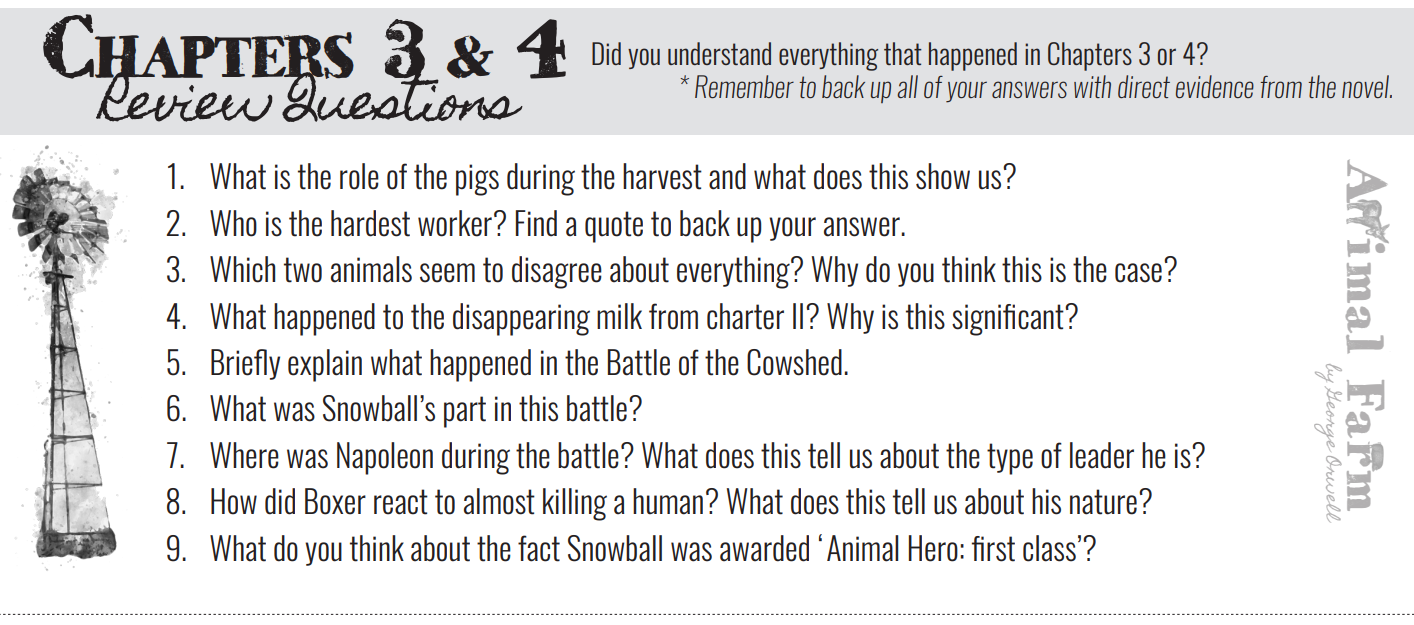
 ANIMAL FARM

We're going to start with a little introduction, then we're going to begin Animal Farm.

HERE IS THE LINK TO THE BOOK

ANIMAL FARM INTRODUCTION

Animal Farm Chapter 1 & 2
  1. List the animals that enter the barn for Old Major’s speech.
  2. If we were to connect each type of animal to a different kind of person in society, what kind of personalities do you think Orwell is describing? Describe the kinds of people represented by the following animals from Chapter 1: 
    1. Boxer 
    2. Pigs 
    3. Mollie 
    4. The Cat 
    5. The Rats 
  3. At one point in Chapter 2, Moses describes Sugarcandy Mountain as a place where animals may go when they die. Since this book is an allegory – what is the true story Orwell may be referring to with the character “Moses” and his stories of Sugarcandy Mountain? 
  4. What do the animals with Mr. Jones’ farming equipment and tools immediately after the rebellion? How might this change the way animals take care of the farm after Mr. Jones is gone? 
  5. What do you suppose happened to the milk at the end of chapter 2? How does this break the rules suggested by Old Major’s speech in chapter 1? 
  6. Why are the animals so eager to do a big, successful harvest at the end of chapter 2?

Friday, 12 July 2024

English 10 Adapted

 THE SCARLET IBIS

  1. Give two examples of pride in "The Scarlet Ibis"
  2. How do the narrator's feelings towards Doodle change over time?
  3. What is one important message that "The Scarlet Ibis" relays to present-day children with siblings?
  4. Where do we see foreshadowing in "The Scarlet Ibis"? Find two examples.
  5. Is the narrator to blame for Doodle's death? Why or why not? (paragraph response)

Friday, 14 June 2024

Introduction to the GLA12

 Greetings all. Though I am away today there are a few additional useful notes here as you begin looking into composition writing.

The GLA12 has two extended responses, the 2nd of which is composition writing. Now, this style of writing is very open-ended. There are no rules in terms of the number of paragraphs and the topics are usually quite broad.

Take a look through the package of sample compositions. Read through it with your table and determine what seems to work well, and what tends to go wrong with this style of writing. Create a list of these items on the board as you read through them.

If you want to see more examples, check out the RESOURCES tab at the top of the page. Under Grade 12 you'll see a link to other sample compositions. There are an additional 6 samples of compositions there.

Tuesday, 11 June 2024

Essay Topic

 Behold - our argumentative essay topic. This one appears simple, yet it is complex. We will need to consider everything we've done up to this point to fuel a solid argument. First, the topic:

Is ambition more helpful or harmful?

Now, let's begin looking at this topic more closely. Consider the following:

  • The Id, Ego, and Superego can inform this argument.
  • Assume the term "helpful" or "harmful" is applied personally (as opposed to being applied to the well-being of others)
  • Consider the relation between goals and ambitions. There are goals we can all agree are good for us, and those we would want to keep private. Think about how we can go about the pursuit of these goals.
  • There are powerful quotes about ambition from many historical figures.
"Ambition is the last refuge of failure" - Oscar Wilde
(this means people who are failures will display ambition to overcompensate for what they lack)

"Great ambition is the passion of a great character. Those endowed with it may perform very good or bad acts. All depends on the principles which direct them." - Napoleon Bonaparte

Remember, you need two supporting reasons with evidence and a counterclaim with evidence.

The legal foolscap page is for quotes ONLY. Leave the back of the pink sheet BLANK before the essay.

Wednesday, 5 June 2024

Try this!

 1.       Should boys and girls be in separate classes?

Tuesday, 4 June 2024

Some practice essay topics

Below are a list of some practice essay topics. We will be addressing these for practice this week :)
  1. Should high school students have to complete community service hours to graduate?
  2. Should unhealthy fast food products be sold with a warning label?
  3. Should students be allowed to drop out before they turn 18 years old?
  4. Should alcohol manufacturers be allowed to advertise on YouTube?
  5. Should the government censor internet content deemed inappropriate?
  6. Should the government composition proportionally represent the ethnic diversity of the general population? (this is termed proportional representation)
  7. Should universities follow the policies of affirmative action to help determine successful applicants?

Monday, 3 June 2024

Ambition and its Influence

 Greetings all, this week we are beginning to move into argumentative writing. This means we need to do some reading outside of Macbeth in order to inform ourselves and our position on this topic. Below are a few links in addition to printouts that we'll be using in class. Some of these links are lengthy, so use the search function on your devices to get to the gist of the argument.

Peer-reviewed journal articles are some of the more reliable sources we can find. There are many sources for these. One example below is remarkably long. Read the abstract of lengthier journal articles to see what general conclusions are proven within. Check it out:

  1. Ambition and Extreme Behaviour
  2. Ambition and its Psychopathologies
  3. Is Ambition Good or Bad? (there is a printout of this one as well)
In our argumentative writing, we'll want 2-3 sources to support our position on the topic of ambition. The specific topic(s) will be coming soon. For now, we must focus on informing ourselves on the role ambition has in our lives, and its positive and negative influences.

Monday, 6 May 2024

Example Topics

1.      How would psychoanalytic literary theory indicate whether the boys on the island were doomed to fail?

2.      Based on Freud’s structure of the psyche, how does Ralph struggle with the contest between his civilized and savage self?

3.      How might The Lord of the Flies be described as an allegory of Freud’s structure of the psyche?

Friday, 3 May 2024

Thesis/Claim Statements

 Practice topics for LOTF:

  1. How does impulse drive the boys' behaviour on the island?
  2. What is the significance of the symbol of fire on the island?
  3. What experiences caused morality on the island to decline so that one may kill another with "delirious abandonment"?
  4. Why is Simon able to commune with "The Lord of the Flies"?
  5. Why was Piggy's death inevitable?

Monday, 29 April 2024

Quote responses LOTF

Pick a quote. Write a paragraph response with LOTF as support:

  • "He who knows no hardships will know no hardihood. He who faces no calamity will need no courage. Mysterious though it is, the characteristics in human nature which we love best grow in a soil with a strong mixture of troubles."
- Harry Emerson Fosdick

  • "Beware that, when fighting monsters, you yourself do not become a monster... for when you gaze long into the abyss. The abyss gazes also into you."
- Friedrich W. Nietzsche

Monday, 8 April 2024

Monday, 11 March 2024

Topics for the paragraph

 Greetings all, here's a list of topics we'll be tackling for March 12.

  1. How does the desire of what we want affect how we treat others?
  2. Can a healthy relationship take place between individuals with a profound age gap?

Block B

 HILLS LIKE WHITE ELEPHANTS

Block C

THE GUEST

Thursday, 7 March 2024

Thursday, 29 February 2024

Wednesday, 28 February 2024

Monday, 26 February 2024

English 11 Block B

 Greetings all! Here comes a new short story - one many of you might be familiar with.

The Tell-Tale Heart

Friday, 23 February 2024

Monday, 5 February 2024

Lottery Questions

 In addition to the themes below, these questions will guide and prepare us for the essay to come on Wednesday/Thursday. Here we go!

  1. What major instances of foreshadowing are expressed throughout the story? 
  2. How does social conformity and fear prevent the villagers from abolishing the lottery tradition?
  3. How does tradition affect the villager’s mindset?
  4. How does “The Lottery” demonstrate how tradition influences our lives?
  5. What does the black box symbolize?